What Does M.a.r.b Mean in Beef Terms
Introduction
Many retained buying programs offering producers the opportunity to receive a level of data from the feed-yard and packing plant that is rarely available after those animals get out the farm. One case is the Georgia Beef Claiming, which gives its participants information on cattle proceeds and carcass information. Table i shows an case of a carcass report received from the Georgia Beef Claiming.
Producers tin can apply this information to make genetic changes in their herd to better the marketability of their calves. To make calves more marketable producers must strive to see industry targets:
| · | Hot carcass weight 600-800 lbs. | · | Yield Course 2 or less |
| · | Fat Embrace 0.3-0.45 inches | · | Quality Grade Select + to Choice |
| · | Rib-middle Area 12.5-14 sq inches |
However, before this information tin can be utilized, producers must empathize what these terms mean. The terminology might exist slightly different on various reports, but the mutual ones used for herd improvements are discussed beneath.
Hot Carcass Weight (HCW) and Dressing Percentage (Dress %)
Hot carcass weight, or carcass weight on some reports, is the hot or un-chilled weight of the carcass afterwards slaughter and the removal of the head, hibernate, abdominal tract, and internal organs. The HCW is used to determine yield grade and too dressing percentage. Dressing percent is the pct of the alive animal that ends upward every bit carcass. It is computed from the following formula:
Dress % = (HCW ÷ live weight) x 100%
Here is an case: A steer has a live weight of 1250 lbs. and later slaughter has a hot carcass weight of 792 lbs.
( 792 ÷ 1250 ) x 100% = 63.36%
He has a dressing pct of 63.36 percentage.
The dressing percentage for beef cattle is normally lx-64percent. Hot carcass weight is a major factor in determining total revenue when animals are sold on a grid. Pricing on a grid is a method of pricing slaughter cattle that offers premiums and discounts for carcasses. Cattle that are leaner and have higher quality grades receive premiums. Grids generally have other specifications for carcass weight and dark cutters every bit well. (Dark cutters refers to beefiness that is dark to almost black resulting in lower quality beef.) Price discounts normally occur for carcasses weighing less than 550 lbs. and more than 950 lbs. Even so, inside the acceptable range for HCW, heavier carcasses result in greater returns.
Fat Cover (BF or FT)
Fat cover, sometimes referred to as back fat or fat thickness, is the measure of the thickness of external fat on the carcass. Information technology is expressed in inches. This measurement is taken over the loin musculus (longissimus dorsi) of the calf between the 12th and 13th ribs at a bespeak three-fourths the length of the ribeye from the split chine os. This measurement may exist adjusted to reflect unusual amounts of fat that are present on other parts of the carcass. Fat cover is another factor used to make up one's mind yield grade. Figure 1 shows where the fatty cover is measured.
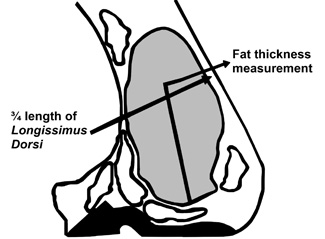 Figure 1. Source: Tatum, Daryl. 1997. Beefiness Facts: Meat Science Beef Grading. pp 1-4. National Cattlemen'south Beefiness Association.
Ribeye Surface area (REA)
Ribeye area is the measure out of the total area of the loin or ribeye (longissimus dorsi) between the 12th and 13th ribs. This measurement is expressed in square inches and can be measured using a grid. Ribeye area is also used in the determination of yield grade. Effigy 2 shows the filigree used to measure ribeye area.
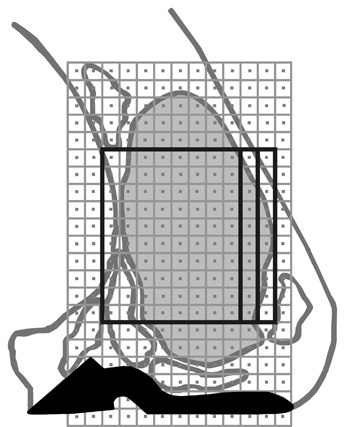 Figure ii.
Percent Kidney, Pelvic, Heart Fat (%KPH)
% KPH is the percentage of total fat found in the body cavity of a carcass specifically in the regions of the kidneys, pelvis, and heart. It is often estimated visually by a USDA grader or information technology can be calculated based on the modify in carcass weight following removal of fat from these areas on the carcass. About carcasses have one to iv percent KPH. It is the last factor used to make up one's mind yield grade.
Yield Grade
The purpose of yield grades is to split up beefiness carcass into cutability groups based on the expected yield of boneless, closely trimmed, retail cuts (BCTRC) from the round, loin, rib and chuck. Yield grades are expressed equally numeric scores 1-5, with one having the greatest percentage of BCTRC and 5 the lowest. The relationship between BCTRC and yield grade is shown in Table 2.
The factors used to summate yield grades include fat cover (FC), hot carcass weight (HCW), ribeye area (REA), and pct kidney, pelvic, heart fat (%KPH). The formula is every bit follows:
USDA Yield Grade = 2.5 + (two.five x FC) + (0.0038 + HCW) + (0.two ten %KPH) – (0.32 ten REA)
Percent Retail Product (%RP)
Per centum retail product is the proportion of the carcass that is trimmed, os-in (or boneless) retail cuts. It is formulated by using the equation below.
% RP = retail cuts weight ÷ carcass weight (chilled) ten 100
Marbling Score (Marb)
Marbling, or intramuscular fat, is the estimate of the corporeality of fat nowadays in the loin / ribeye (longissimus dorsi) muscle. Graders evaluate the corporeality of intramuscular fat at the cut surface of the ribeye on the 12th rib surface. There are ix marbling scores and each of these is divided into 100 subunits. They are assigned as subscripts to the scores ranging from 00 to 99, representing the least and greatest amount of marbling within the score.
| The marbling scores (to the lowest degree to greatest) are: | |
| i. | Practically Devoid (PD) |
| 2. | Traces (TR) |
| 3. | Slight (SL) |
| iv. | Pocket-size (SM) |
| 5. | Minor (MT) |
| 6. | Moderate (Medico) |
| seven. | Slightly Abundant (SLAB) |
| 8. | Moderately Arable (MDAB) |
| 9. | Abundant (AB) |
Caste of marbling in immature cattle (< 30 mo.) is the primary determinant of quality grade.
Quality Grade
The purpose of quality grades is to segregate beef carcasses into palatability groups based on the expected eating quality. Quality grades are based on degree of marbling and carcass maturity. Carcass maturity groups range from A to E and are an judge of the animal'south age from which the carcass was derived. Maturity grouping A cattle are estimated to exist between ix – thirty months old, while grouping E cattle are greater than 96 months. The quality grades are (from nearly palatable to to the lowest degree) Prime number, Choice, Select, Standard, Commercial, Utility, Cutter, and Canner. The relationship between marbling, maturity and quality grades are shown in Figure 3.
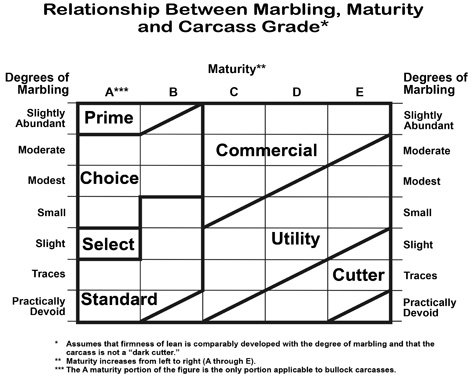 Figure iii.
Summary
Understanding the data provided on a carcass data report is vital to beingness able to utilize information technology to brand improvements in the herd. Beefiness is the ultimate product in cattle production and making that product better and coming together the demands of packers and consumers volition ensure a higher turn a profit for producers. According to the 2005 National Beef Quality Audit these are the goals that producers need to strive for:
1. Deliver product attributes that meet consumer needs/expectations for safety, gustatory modality, color and convenience.
two. Better cattle past implementing instrument grading; reducing numbers of YG 4 or 5 carcasses; controlling carcass weight; increasing marbling; decreasing variation, and maximizing profitability.
iii. Expand marketing opportunities (in domestic and global markets) by developing traceability systems; verifying source and age; reducing costs and waste in the beef value chain, and continuing new product development.
Only with proper agreement of carcass data reports can producers achieve these goals and be more prepared to come across industry targets.
1County Extension ANR Agent - Bulloch Canton
Status and Revision History
Published on Feb 28, 2007
Published on Feb 04, 2009
Unpublished/Removed on Mar 01, 2010
Published on Sep x, 2010
Published with Full Review on Sep 11, 2013
Published with Full Review on Jan 05, 2017
Published with Full Review on Jan 05, 2017
Source: https://extension.uga.edu/publications/detail.html?number=B1326&title=Understanding%20Beef%20Carcass%20Reports
0 Response to "What Does M.a.r.b Mean in Beef Terms"
Post a Comment